
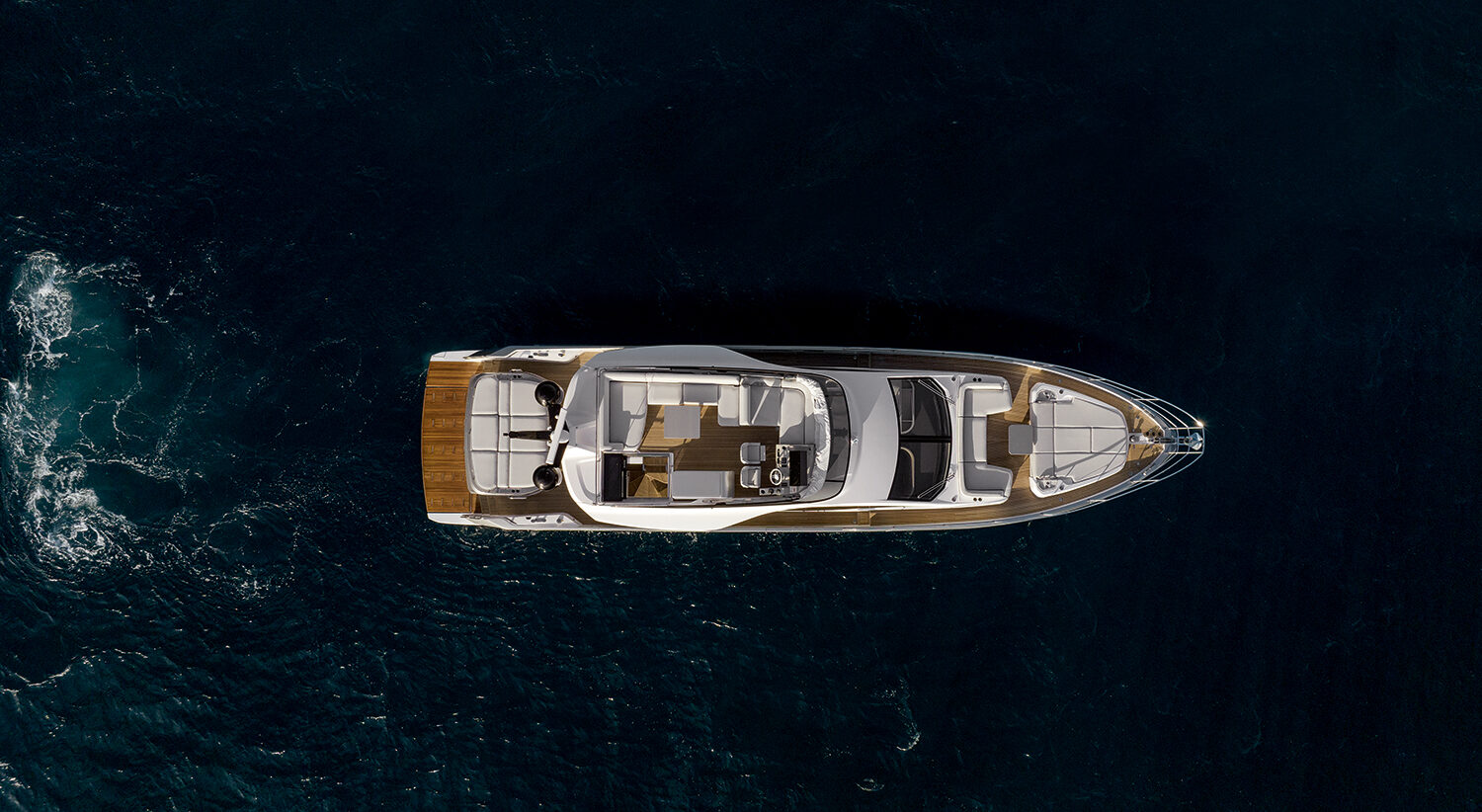
For many owners, a yacht part exchange is the most elegant way to move from an existing model to a new yacht without having to manage two transactions simultaneously. Rather than spending months marketing the old yacht privately, it is offset directly against the purchase price of the new one. What sounds straightforward does, in practice, have a number of variables that determine whether the transition is seamless or drawn out.
In This Article
- What does yacht part exchange actually mean?
- How is your yacht valued?
- Yacht purchase: what dealers really look at
- Trading your yacht rather than selling it: the benefits of trade-in
- Yacht trade-in: the process at Yachtwerk
- From initial enquiry to handover
- Financing and tax considerations
- Choosing the new model: Azimut ranges at a glance
- Frequently asked questions
Key Takeaways
- A yacht part exchange combines the purchase and sale into a single, coordinated transaction, sparing the owner the effort of running both in parallel.
- The part-exchange value depends primarily on year of build, service history, equipment specification, and the model’s saleability – not on the list price alone.
- Yachtwerk provides a no-obligation valuation of your current yacht and issues a written purchase offer before you commit to buying the new model.
- Our base at Marina D-Marin Mandalina in Šibenik allows technical inspections and deliveries to be handled directly in Croatian waters.
- Current part-exchange values and terms for your specific yacht are available on request at yacht-werk.de/kontakt.
Yacht Part Exchange: What the Model Actually Means
In a yacht part exchange, the dealer accepts the buyer’s existing yacht as part of the consideration for a new or pre-owned yacht. The market value of the yacht being handed over is established, recorded in writing, and deducted directly from the purchase price of the new model. The buyer pays only the difference – either from their own funds or through financing.
The model has been firmly established in the automotive industry for decades, but it is considerably more complex in the yachting world. Yachts are configured far more individually, the markets are smaller, and condition varies far more significantly than it does among vehicles of the same year. A credible yacht part exchange therefore requires thorough pre-inspection and clear contractual terms.
For owners wishing to acquire a new Azimut yacht, a yacht part exchange is often the most efficient route. It avoids the cost of running two yachts simultaneously – double berth fees, insurance, and maintenance – an aspect that owners in the mid and upper segments particularly appreciate.
Part Exchange Versus Private Sale: What Are the Arguments for Each?
An owner who sells privately may, under favourable circumstances, achieve a higher net return than through a yacht part exchange. However, they also bear all the risks: viewings, negotiations, liability questions, delivery costs, and often months of waiting. Selling a large motor yacht privately rarely takes less than six months.
A yacht part exchange, by contrast, offers planning certainty. The part-exchange value is agreed in advance, the handover is coordinated to a fixed schedule, and the owner is immediately free of any legal responsibility for the old yacht – with no renegotiations, warranty disputes, or risk of the deal unravelling due to a private buyer. For UHNW clients whose time is a scarce resource, this difference carries considerable weight.
How Is Your Yacht Valued?
The valuation is the most critical step in any yacht part exchange. It is not based on intuition but on a structured analysis of the market, condition, and specification. We begin with a preliminary assessment based on photographs, maintenance documentation, and year of build, followed by a physical inspection by an experienced surveyor.
The key factors determining the part-exchange value are: a complete service history with supporting documentation, the technical condition of the drivetrain, electrics, and navigation equipment, the age and running hours of the engines, and any damage or repairs with supporting evidence. Well-documented yachts consistently achieve higher purchase values than comparable models with incomplete service records.
The current market also plays a role. Models that are straightforward to resell are valued more generously. Unusual configurations or rare colour schemes can reduce the part-exchange value because the dealer carries a higher resale risk. This is not a hidden deduction – it is commercial reality.
Why an Independent Surveyor Is Worthwhile
An independent surveyor engaged by the owner significantly strengthens their negotiating position. A current survey report documents the yacht’s condition objectively and protects both parties from subsequent disagreements. In a yacht part exchange, I would always recommend not skipping this step – regardless of how well the owner believes they know their own yacht.
The survey typically covers hull, drivetrain, systems, and safety equipment. Any deficiencies can be rectified in advance, which improves the part-exchange value. Alternatively, they are factored into the purchase offer and the associated cost is priced in accordingly.
Yacht Purchase: What Dealers Really Look At
From the dealer’s perspective, buying a yacht follows a clear logic: what can be resold, at what price, and within what timeframe? Yachts that align with the dealer’s own brand and for which there is an active market are preferred acquisitions. As an authorised Azimut dealer, we naturally focus on models we know well and that our clients are actively seeking.
When purchasing a yacht, we examine not only its technical condition but also its legal status. Outstanding finance, registered mortgages, or liens must be resolved before or at the point of transaction. This is not bureaucracy – it is a necessary safeguard for all parties involved. We typically coordinate this process directly with the banks concerned.
Flag-state documentation is particularly relevant when purchasing a yacht. A yacht registered in Germany or another EU member state with no VAT complications is considerably easier for us to trade than an offshore-registered vessel with an uncertain VAT status. Such situations can be resolved, but they require additional lead time and external legal advice.
Do You Also Accept Non-Azimut Yachts in Part Exchange?
Yes, in principle. A yacht part exchange is not restricted exclusively to Azimut yachts. We assess yachts of other brands on a case-by-case basis, provided a realistic onward sale is feasible. What matters less is the brand and more the condition, size, and saleability of the model in Germany and Croatia.
Owners of yachts from other shipyards who wish to move to an Azimut or Maiora should send us the details of their existing yacht at an early stage. This allows us to assess whether a purchase is realistic before they invest time in evaluating the new model in depth.
Trading Your Yacht Rather Than Selling It: The Benefits of Trade-In
Trading in your yacht is more than a matter of convenience. In many cases it is the most financially rational decision, once all cost components are honestly calculated. An owner selling privately must account for broker’s fees, survey costs, any repairs required to prepare the yacht for sale, listing costs, and the risk of lost time.
When trading a yacht through a part exchange, many of these items are absorbed by the dealer. The owner pays for this with a part-exchange value that is typically lower than an achievable private sale price – but the difference is often smaller than the total cost of the savings made. This requires a clear-headed calculation.
Interested in a Yacht Part Exchange?
When Is the Right Time to Make the Switch?
The optimal moment to trade a yacht is usually at the end of a maintenance cycle, before a significant investment becomes due. A yacht that will require an engine service or an extensive refit within the next year or two loses meaningful value at appraisal – and if an owner waits too long, the forthcoming costs frequently outweigh any additional benefit derived from continued use of the yacht.
Owners who switch when the yacht is in good condition consistently achieve better part-exchange values. That means keeping service records current, addressing minor defects promptly, and not waiting until the yacht visibly signals that it needs attention. Those who maintain their yacht well are rewarded when it comes to trading in.
Yacht Trade-In: The Process at Yachtwerk
Our yacht trade-in process runs through several clearly defined stages. The first step is always a confidential initial enquiry, in which the owner provides basic information about the existing yacht: brand, year of build, engine hours, berth location, and service status. This information forms the basis of a preliminary assessment.
The second step is a physical inspection, carried out either by our team or an appointed surveyor. In the yacht trade-in process, the better prepared the yacht is for inspection, the smoother the process. Clean documentation, available logbooks, and accessible service contacts significantly accelerate the valuation.
Following the inspection, you receive a written purchase offer. This offer is binding for a defined period and forms the basis for the overall calculation of the new purchase. The purchase agreement is drawn up only once both elements – the part-exchange value and the purchase price of the new model – have been agreed in writing. No owner is ever asked to sign blind with us.
What Happens to the Yacht Being Handed Over?
After handover, the yacht is taken into our stock. Depending on its condition, a preparation process follows: exterior cleaning, technical inspection, and where necessary minor remedial work. Our base at Marina D-Marin Mandalina in Šibenik is an excellent facility for this work, as technical service providers are on site and the yacht can be positioned with strong visibility in the Croatian market.
For the owner handing over the yacht, the process is complete at that point. They bear no further liability for the yacht after handover and need take no further action. This is a significant difference from a private sale, where warranty questions can arise even after the handover has taken place.
From Initial Enquiry to Handover of the New Yacht
For well-prepared owners, the entire yacht part exchange process typically takes between four and eight weeks from the first conversation to handover of the new yacht. More complex situations – offshore-registered yachts, outstanding finance, extensive surveys – can take longer. We communicate this transparently from the outset.
Throughout the process, we also guide the client in selecting the new model. Owners who come to us to trade in a yacht usually have a clear sense of the direction they wish to move in: more space, greater range, a different concept. We are happy to have that conversation early in the process, so that the planning is grounded in reality.
Our showroom in Grünwald near Munich – located at the Yachtwerk Showroom at Motorworld München – is where many clients prefer to have their first face-to-face meeting, before a visit to the marina follows. This saves time and gives both parties a shared picture of what the next step should be. From the initial consultation through to handover, a dedicated contact at Yachtwerk accompanies the entire process.
Delivery and Familiarisation After the Trade-In
Delivery of the new yacht – whether from the shipyard in Avigliana, from the berth of another vessel, or from our base in Croatia – is a service we coordinate as part of the process. Our service offering encompasses not only deliveries but also technical familiarisation, refit consultancy, and after-sales support. An owner taking delivery of a new Azimut should feel fully confident and in command of the vessel from day one.
Particularly for owners moving from a smaller to a larger segment, familiarisation is not an optional extra but a sensible component of the overall package. The handling characteristics change, and an owner who knows the new model enjoys it considerably more from the very beginning.
Financing and Tax Considerations in a Yacht Part Exchange
A yacht part exchange alters the financing structure of the new purchase. Because part of the purchase price is covered by the value of the yacht being handed over, the amount to be financed is reduced. This can improve the terms of a financing arrangement or shorten its duration. In either case, early coordination with a financing partner is advisable.
From a tax perspective, a yacht part exchange in Germany is treated in essentially the same way as a standard purchase and sale transaction. VAT is payable on the full purchase price of the new model, not on the difference. This is a common misconception that we address regularly in our conversations. Owners who approach the planning without being aware of this can encounter an unwelcome surprise when it comes to managing their liquidity.
Additional tax considerations apply to yachts operated commercially or placed in charter. In such cases, we always recommend involving a tax adviser specialising in maritime transactions. Our network of partners includes the relevant specialists, whom we can refer clients to on request.
Choosing the New Model: Azimut Ranges at a Glance
The yacht part exchange is the starting point – the goal is finding the right new yacht. Azimut offers a broad range of model lines that clearly address different usage profiles. The choice depends on how and where the yacht will be used.
The Fly and Flybridge range is the classic choice for owners seeking a well-balanced combination of comfort and handling. The Azimut Fly 62 and the Azimut Fly 78 are typical examples for families who cruise the Mediterranean extensively and value generous cabin capacity alongside comfortable handling.
The Seadeck range follows a different concept: open in character, oriented towards day cruising and socialising, with a hybrid deck-saloon layout. The Azimut Seadeck 7 is a good example of a model chosen by owners who prioritise the on-deck experience during the day and have less need for multiple separate cabins.
The Grande range is aimed at owners in the upper segment who seek stability, volume, and a commanding presence. Models such as the Azimut Grande 26M represent not an entry-level consideration but the natural next step for owners who are familiar with the mid-range segment and are ready to move decisively upward.
The Magellano line appeals to long-distance cruising enthusiasts. The trawler-style design combines comparatively low fuel consumption with excellent seakeeping and substantial range. For owners heading to the Atlantic or destinations beyond the Mediterranean, the Magellano range is a serious option worth considering. For current models and specifications, I would recommend consulting the model overview on our website.
How Do I Find the Right Model for My Next Step?
The conversation about the new model always begins with the cruising grounds and intended use. Croatian islands demand different characteristics from a yacht than the North Sea or the Atlantic. Owners who primarily entertain friends at weekends or charter need different capacities from those who spend extended periods living aboard with their families.
We have this conversation at a measured pace, without pressure. A yacht part exchange is not an impulse decision, and we do not treat it as one. Owners who are unsure which model is right for them can gain a realistic impression at our showroom or during a sea trial in Šibenik – before they sign anything.
Frequently Asked Questions
How Do I Find Out What My Yacht Is Worth in a Part Exchange?
We can only provide an exact part-exchange value after a full assessment comprising a documentation review and physical inspection. A preliminary indication is often possible based on photographs, year of build, and engine hours alone. Please send us the relevant details via our contact form – we will respond promptly with an initial assessment.
How Long Does the Entire Trade-In Process Take?
For well-prepared owners with complete documentation, four to eight weeks is a realistic timeframe – from the first conversation to handover of the new yacht. More complex situations, such as outstanding finance or non-EU registration, will extend the timeline. We communicate the schedule transparently from the very beginning.
Does My Existing Yacht Have to Be an Azimut to Be Accepted in Part Exchange?
Not necessarily. We also assess yachts from other manufacturers as part of a yacht part exchange, provided a realistic onward sale is achievable. Condition, size, and market saleability are the decisive factors. In such cases, we ask owners to get in touch at an early stage so that we can assess feasibility in advance.
Why Is the Part-Exchange Value Often Lower Than the Private Sale Price?
The dealer carries the risk of onward sale, the costs of preparation, survey, and any necessary repairs, as well as the cost of capital during the time the yacht is held in stock. These costs account for the difference between the part-exchange value and the price achievable through a private sale. In many cases, this difference is smaller than the total cost an owner would incur by selling privately.
Can the Yacht Part Exchange Also Be Handled in Croatia?
Yes. Our base at Marina D-Marin Mandalina in Šibenik allows us to coordinate both the handover of the existing yacht and the collection of the new one directly in Croatian waters. This is particularly practical for owners whose yacht is already berthed in Croatia and who wish to begin the new season there. The specific logistics can be discussed on an individual basis.

Ernst Nassl
COO, Sales & Marketing — Yachtwerk (Authorised Azimut Dealer)
Many years of experience in the yachting market. Your personal point of contact for new yachts, financing, and strategic advice. Direct connection to the Azimut shipyard in Avigliana.


