

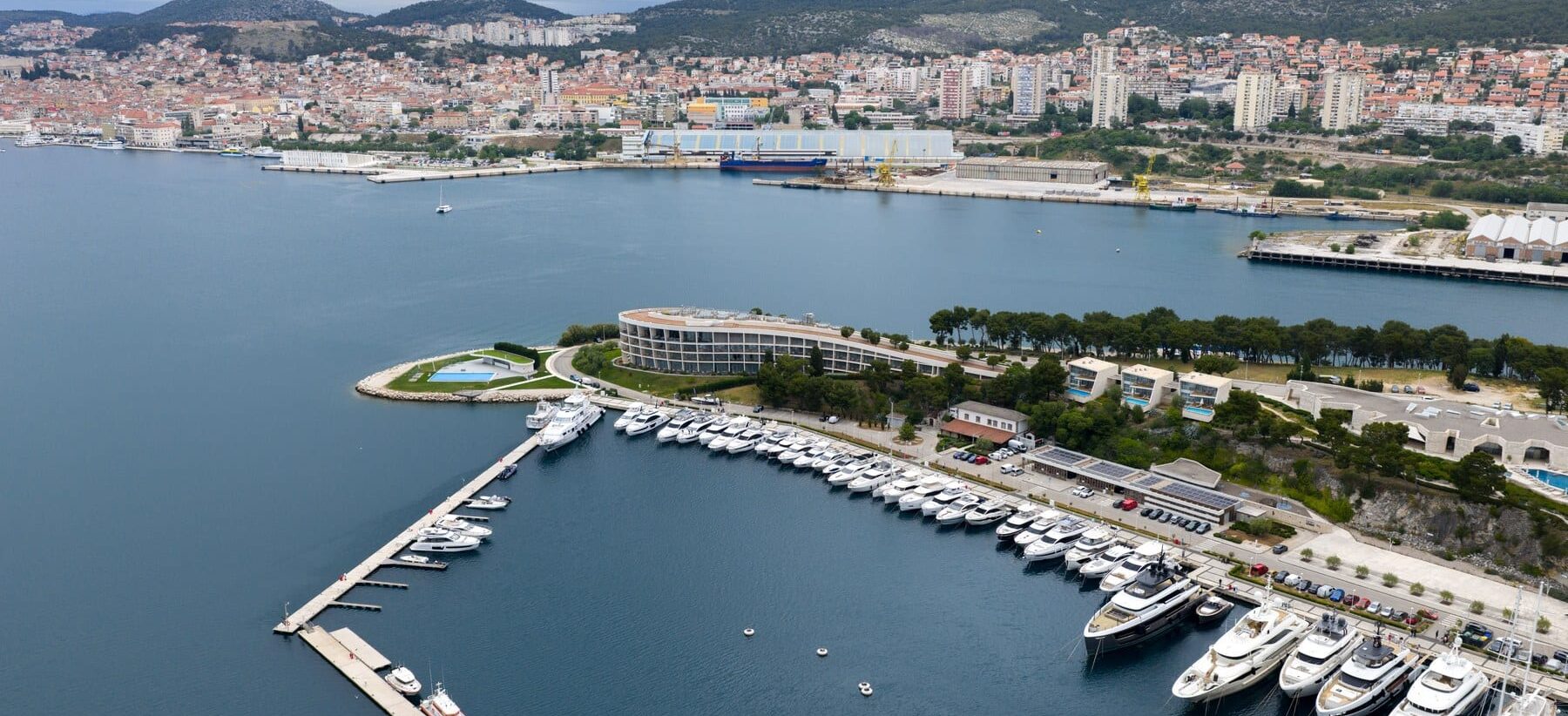
Anyone who regularly cruises Croatia or the Italian Adriatic eventually faces a question that goes beyond the boat purchase itself: buy a berth or keep renting? The answer depends on how long you intend to use it, the cruising ground in question and your financial planning, but it can be assessed against clear criteria. In this article, I share the experience we gather daily at Yachtwerk with our customers at the D-Marin Mandalina marina in Šibenik and in other cruising grounds.
In this article
Key points at a glance
- Buying a berth generally only pays off once you plan to use the same location for several years, since running costs and purchase price must be weighed against ongoing rental fees.
- In Croatia, berth ownership is often legally structured as a long-term usage right (a concession) rather than freehold property in the sense understood under German law.
- Buying a boat berth in sought-after marinas such as Mandalina in Šibenik or along the Italian Riviera can support the overall value stability of your yacht investment.
- Marina purchase agreements vary considerably by country: Croatia, Italy, Spain and France each have their own concession and ownership models.
- Yachtwerk advises customers on this decision as part of the entire purchasing process, from model selection through to delivery and after-sales support.
Buying a berth: what it actually means
Buying a berth doesn’t automatically mean acquiring a piece of water as freehold property. In most Mediterranean cruising grounds, what you actually acquire is a long-term usage right to a specific box or pier position, often running for 20, 30 or even 99 years, complete with transfer and inheritance rights. This differs fundamentally from a rental agreement, which is usually renewed annually or seasonally and can often be terminated at any time.
Anyone looking to buy a berth is therefore primarily buying planning certainty and a tradeable right, not necessarily physical freehold property. At the D-Marin Mandalina marina in Šibenik, for instance, our own base in Croatia, berths operate via concession models with the relevant port authority. This structure is typical of Croatian marinas and differs from Italian or Spanish models, some of which grant genuine part-ownership of the infrastructure.
What does a berth cost compared with renting?
Actual purchase prices for berths vary enormously depending on the marina, the position within the facility and the permitted boat length, which is why we won’t cite any invented figures here. As a rough guide: the closer to the main pontoon, the more sheltered from swell, and the greater the permitted boat length, the higher the premium over a standard berth. For current terms on berths within our network, please get in touch via a personal enquiry with our team.
Renting a berth or buying one in a marina: the maths behind it
At its core, the choice between renting and buying a berth comes down to intensity of use. Anyone who only takes their yacht out for a few weeks a year and moves between different marinas, say between Šibenik, Split and the Istrian coast, generally benefits from the flexibility of renting. Anyone establishing a fixed home port, where crew, servicing and maintenance are organised around one location, will find the maths shift in favour of ownership.
One important factor many buyers underestimate: in premier cruising grounds such as the Côte d’Azur or indeed Šibenik, free berths during the season are effectively unavailable, even for a price. Anyone planning to cruise there long-term secures capacity through ownership or a multi-year concession agreement, not through last-minute booking enquiries in May for August. This often makes buying a berth the only practical option for owners who want reliable seasonal planning.
Why waiting lists influence the buying decision
Many established marinas, such as Portofino, Porto Cervo, or parts of the Croatian D-Marin group, have multi-year waiting lists for fixed berths in the sought-after size categories. Buying early, rather than waiting, not only secures the berth but often locks in a price below future revaluations. This scarcity is one of the main reasons why buying a marina berth has evolved in recent years from a niche decision into a firm part of investment planning for larger yachts.
Berth ownership: advantages and limitations
Berth ownership brings tangible advantages that go beyond simple availability. Owners can let out their berth when their own yacht isn’t on site, which helps offset fixed costs for seasonal users. The usage right can also be sold separately from, or together with, the yacht, which in sought-after locations supports the resale value of the overall package.
The limitations mainly concern legal complexity. Concession agreements in Croatia, for example, run for fixed terms and must be renewed or renegotiated before expiry, which requires additional due diligence in the event of a change of ownership. Furthermore, the land and the marina itself generally remain the property of the operator or the state, with the buyer acquiring only the usage right to the water area and pontoon.
Maintenance and ongoing running costs
Even as the owner of a berth, ongoing costs apply: marina fees for electricity, water, security and general infrastructure are charged regardless of ownership status. These running costs need to be calculated separately from the purchase price and vary considerably depending on the marina’s standard, for example between a simple fishing harbour and a five-star facility such as Mandalina with its attached resort. We’re happy to discuss exact cost structures in a personal consultation, as they can be adjusted annually.
Interested in buying a berth?
Buying a boat berth: which cruising grounds are suitable
Not every cruising ground is equally suited to buying a long-term boat berth. Three factors are decisive: tourist and nautical demand at the location, the quality of the infrastructure, and the legal stability of the concession model. Croatia scores well here with a combination of sheltered bays, short distances between marinas and a growing number of international marina operators such as D-Marin.
Marina Mandalina in Šibenik, barely 50 kilometres from the Kornati and Krka national parks, has become one of the most sought-after superyacht bases on the Croatian Adriatic in recent years. More background on the local infrastructure can be found in our article on Marina Mandalina in Šibenik. Directly adjoining it is the D-Resort Šibenik, whose range of services we described in our article on the D-Resort Šibenik.
Italy, Croatia or Spain: a comparison of ownership models
In Italy, marina concessions are state-regulated and often subject to stricter building regulations, which slows down new developments but keeps existing berths stable in value. Spain has regionally varying models, ranging from municipal concessions to private marina operators with their own title deeds. Croatia tends to sit between the two in terms of price and legal structure, offering comparatively accessible entry terms alongside rising international demand, particularly around Split, Zadar and, of course, Šibenik.
Process, financing and legal pitfalls
The purchase process for a berth usually runs in parallel with the yacht purchase but follows its own legal steps. First, the marina’s concession deed or proof of ownership is checked, ideally by a local lawyer specialising in maritime law. This is followed by the transfer of the usage right, which in Croatia must be formally confirmed by the relevant port authority (Lučka uprava).
At Yachtwerk, we support this process as part of our overall service, since our own base at Marina Mandalina gives us direct contact with the marina administration and local partners. Details on financing, delivery and ongoing service are brought together on our services page, which also covers questions relating to marina matters. Anyone additionally interested in charter models as an interim step will find background information in our article on Splendid Yachting Charter.
Can a berth be included in financing?
In practice, berth financing is less commonly offered as a standalone product than yacht financing, but it can often be structured as part of an overall package with many banks. What matters here is that the bank legally recognises the underlying ownership or concession model of the country in question, which isn’t something every German bank automatically does with Croatian usage rights. We recommend clarifying this financing question early on, alongside your model selection, for instance during a visit to our showroom at Motorworld Munich.
How do you resell a berth later on?
Reselling a berth works in a structurally similar way to the initial purchase, with the difference that the marina administration usually holds a right of first refusal or at least a right to approve the new user. In sought-after locations such as Mandalina, this process tends to move quickly in practice, as demand clearly outstrips the available berths. Berths that can also accommodate larger yachts in the upper length classes, such as models from the Grande flagship range or the Fly series, tend to hold their value particularly well.
Which Azimut range suits which berth?
The choice of berth is directly linked to yacht size and your intended cruising profile. Anyone planning mainly day trips and short cruises along the coast will be well served by a more compact berth for models such as the Seadeck 7, whose open concept lends itself to short distances between pontoon and boat. For long-range, trawler-style cruising, berths with greater water depth are needed, such as those required by models in the Magellano range.
Anyone planning to own a flagship from the Grande segment or the larger Fly series, such as the Fly 82, should check early on whether the berth under consideration meets the technical requirements for draught, power and water connections. Not every marina offering berths has the necessary infrastructure for yachts in the upper length classes, which is why it’s worth consulting your model advisor before making a final berth decision. An overview of all our ranges can be found on our models page.
Frequently asked questions
Is buying a berth worthwhile for a single yacht?
Yes, provided the yacht stays in the same cruising ground for several years and the location is one of the sought-after marinas. If you frequently change location between different cruising grounds, renting generally remains the more economical and flexible solution.
Can I buy a berth in Croatia as a foreigner?
In principle, yes, although legally this usually constitutes a long-term usage right via a concession rather than freehold property in the sense understood under German law. The exact arrangement depends on the individual marina and the relevant port authority, which is why we always recommend a local legal review before signing any contract.
What happens to the berth if I sell the yacht?
The berth and the yacht are legally separate assets and can be sold independently of one another. In practice, many owners sell both together to the same buyer, since an established berth in a sought-after marina increases the overall value of the package.
How does Mandalina differ from other marinas in Croatia?
Mandalina in Šibenik combines a sheltered position within the Krka river delta with direct access to a five-star resort and short distances to the Kornati and Krka national parks. This makes the location particularly attractive for owners of larger motor yachts seeking both service quality and nautical variety close by.
Does Yachtwerk also support berth purchases independently of a yacht purchase?
Yes, we also advise customers primarily interested in a berth, for instance as part of a planned investment or an upcoming yacht purchase. Please get in touch directly via our contact page, and we’ll discuss your individual circumstances in a personal consultation.
Further technical information on Azimut ranges and the shipyard’s heritage in Avigliana can also be found directly from the manufacturer at azimutyachts.com.

Ernst Nassl
COO – Sales & Marketing — Yachtwerk, authorised Azimut dealer
Many years of experience in the yacht market. Your personal point of contact for new yachts, financing and strategic advice. A direct line to the Azimut shipyard in Avigliana.


